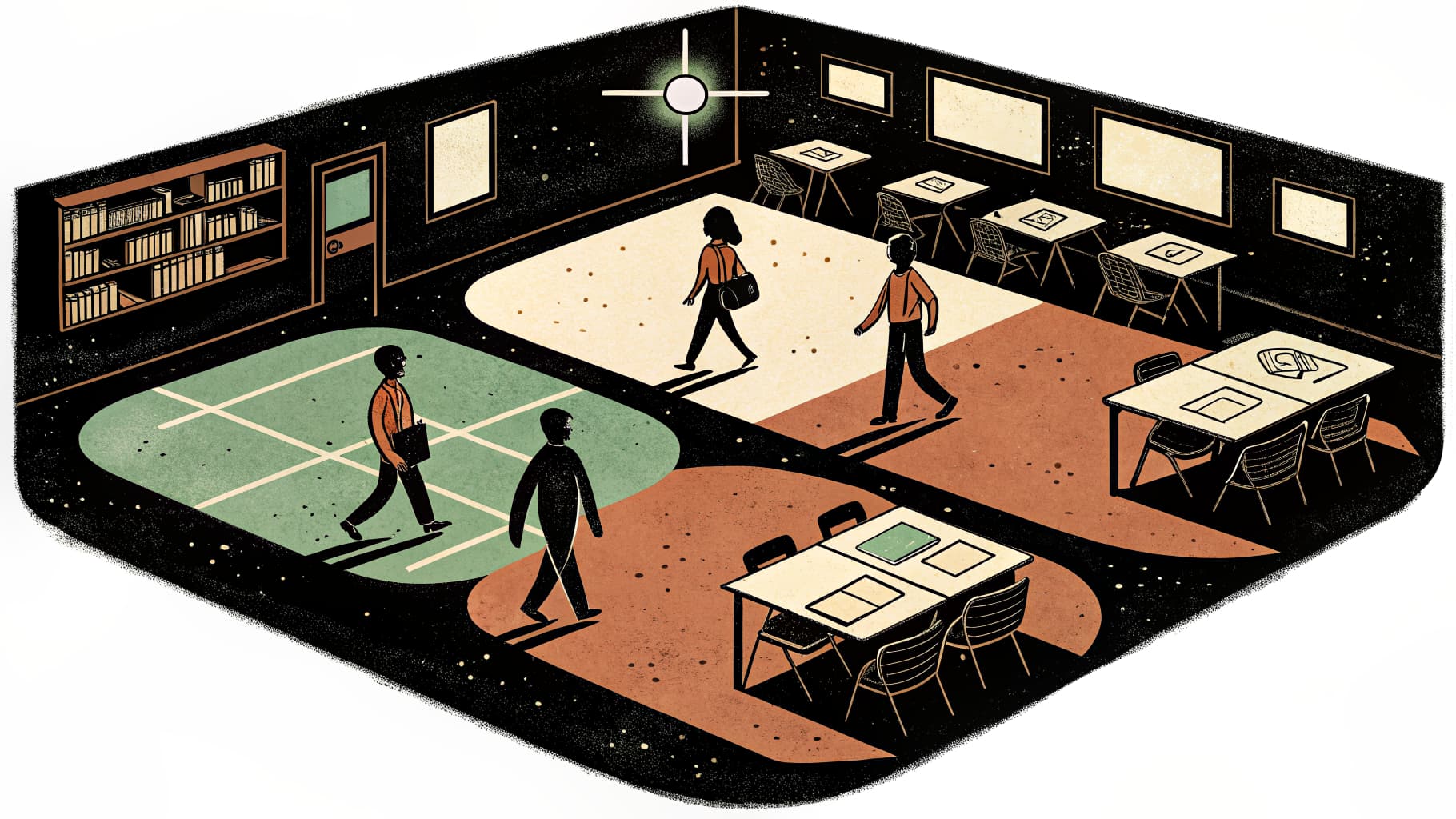
Picture a 10th-grade English class the day before a unit exam on The Great Gatsby. The teacher asks students to open their notes for review. Half the class zones out within five minutes. The same three students answer every question. The teacher wraps up with "any questions?" and gets silence. Nobody learned much from that review session.
Now picture the same class running 20 minutes of academic speed dating. Every student talking. Every student listening. Every student walking out with a page of notes they generated themselves from conversations with eight different peers. That's not a marginal improvement in review quality, it's a structural one.
Academic speed dating borrows the mechanics of its social namesake, timed, one-on-one exchanges with a rotation system, and repurposes them for intellectual work. The format arrived in educational settings in the early 2000s and spread quickly because it solved a real classroom problem: how do you give every student multiple exposures to the same content, in a short time, while keeping energy high?
What Is Speed Dating?
In a speed dating session, students sit in two facing rows or two concentric circles, paired with the person across from them. For a set interval, typically 2 to 3 minutes, the pair discusses a prompt, explains their assigned concept, or responds to a question together. When the signal sounds, one row shifts by one seat and every student has a new partner. The sequence repeats for as many rotations as the lesson requires.
The format's classroom potential is well documented: speed dating effectively breaks down social barriers and increases student engagement by enabling rapid, meaningful peer-to-peer interactions. The combination of brief time pressure, a new partner, and a clear prompt keeps students mentally active in a way that open-ended group discussion rarely does.
The pedagogical logic connects directly to retrieval science. Each rotation is another retrieval attempt, the student pulls the same information from memory, reframes it for a new partner, and responds to that partner's questions or misconceptions. This is spaced retrieval practice happening in real time, in a social context that makes the process more motivating than a solo review sheet. Elizabeth Barkley, K. Patricia Cross, and Claire Howell Major note in Collaborative Learning Techniques (Jossey-Bass, 2014) that structured peer interaction techniques improve critical thinking and help students internalize academic vocabulary through repetitive application.
Speed dating also addresses a persistent equity problem in classroom discussion. In a whole-class format, a handful of students carry the conversational load while the rest observe. In speed dating, there is no option to stay quiet, you're either sharing or listening, and then you switch. The University of Amsterdam's Teaching and Learning Centre notes that the format lowers the barrier to participation by keeping interactions small and time-limited, which reduces the social risk that keeps quieter students silent in full-class settings.
How It Works
Step 1: Prepare Prompts or Assign Roles
Before class, decide what each student will bring to the conversation. Two approaches work well. In the prompt-card model, every student can see the same set of discussion questions, and each rotation covers a new prompt from the list. In the role model, each student is assigned a specific concept, vocabulary term, historical figure, or data set to represent, they explain their assigned material to each new partner and field questions about it.
The prompt-card model works well for review and multi-perspective discussion. The role model works better for vocabulary development and content jigsaw tasks, where you want each student to develop deep knowledge of one piece of the topic and spread it across the room.
Vary the cognitive demand of your questions across rotations. Start with recall, move into application, end with evaluation or synthesis. A session where every prompt asks students to define a term produces surface-level retrieval. A session that moves from "What does cellular respiration produce?" to "Where in the cell does each stage occur?" to "Why would a cell prioritize anaerobic respiration over aerobic?" takes students through a genuine cognitive progression across a single activity.
Step 2: Arrange the Room
Set up two facing rows of chairs or desks, or, if space allows, two concentric circles. What matters is that every student can see their partner clearly and rotate quickly without confusion. For facing rows, the convention is that one row stays stationary while the other shifts one seat at the end of each round. For concentric circles, the outer ring rotates clockwise.
Establish which row moves and which stays before the session begins. Students should know their rotation direction automatically, without having to stop and think about it mid-transition.
Step 3: Teach the Rotation Protocol Before You Start Content
This is the step that determines whether the session runs smoothly or collapses. Before any content is introduced, walk students through one practice rotation. Signal the transition, watch the moving row shift, confirm everyone has a new partner. Do it once more. A five-minute logistics rehearsal at the start of your first speed dating session pays that time back many times over.
A well-managed 30-second transition in a class of 30 can still consume 4 minutes across 8 rotations, and that's instructional time worth protecting. Use a consistent, unambiguous signal: a bell, a timer alarm, or a two-clap sequence. Verbal instructions ("okay, rotate!") get lost when students are mid-sentence and not watching you.
Step 4: Run the Rounds
Start the timer and let the first round begin. Circulate around the room rather than standing at the front. Your job during rounds is to listen and observe, not to intervene constantly. You're gathering formative data: which concepts are students explaining correctly, where are the recurring misconceptions, which prompts are generating genuine discussion versus rote recitation. Save your corrections for the debrief.
Faculty Focus emphasizes that the instructor's role during rounds is to maintain pace and remain available for brief clarifications, not to lecture. The energy of the activity lives with the students. Your job is to keep it moving and keep your ears open.
Step 5: Give Students a Way to Record What They Hear
This is the most frequently skipped step, and skipping it is a genuine mistake. Students who rotate through eight partners without recording anything have had eight conversations and retained the output of maybe two of them. A simple note-taking template, two columns, "What I shared" and "What I learned from my partner", creates a tangible artifact of each exchange and a mild but real accountability for actually listening. If you have to write down what your partner said, you have to listen to what your partner said.
The template also creates study material. At the end of the session, a student who used it has a multi-perspective summary of the topic, written in their own hand, drawn from eight different peer explanations. That's a study resource worth having.
Step 6: Debrief and Consolidate
Research consistently points to the reflection phase as the step that determines whether speed dating produces lasting learning or just productive noise. The debrief is where learning consolidates. Give students 3 to 5 minutes to write individually: What are three things you learned from partners that you didn't know at the start? What idea came up in multiple conversations? What question are you still sitting with?
Then open a brief whole-class share. Call on a few students to name their most useful insight. Explicitly address any misconceptions you heard during your circulation. Bridge to the next lesson or assessment. The Society for the Teaching of Psychology describes this consolidation phase as essential to moving the activity's social energy into durable individual understanding.
Tips for Success
Rotation intervals need to be long enough for genuine exchange. Thirty-second rounds don't allow pairs to greet, share, respond, and record anything meaningful. Even for quick review tasks, give students at least 2 to 3 minutes per rotation. If you have only 10 minutes for the activity, run 4 quality rounds rather than 8 rushed ones, depth beats volume here.
Speed dating can drift toward students reciting prepared talking points without processing what they hear. Build in an active listening checkpoint every 3 to 4 rotations: before the next rotation, ask students to briefly tell their current partner one thing they learned from their previous exchange. This keeps listening genuine and gives you a real-time read on whether the content is landing.
Transition logistics can quietly sink an otherwise strong session. With 30 students moving simultaneously, unmanaged rotations eat instructional time and raise room noise to a level that takes a full minute to bring back down. One row moves, one row stays. Everyone knows which they are before the session starts. The transition signal is consistent and non-negotiable. Practice it once before content is introduced.
Varying cognitive demand across rotations is what separates speed dating from glorified flashcard review. A session built entirely on recall exercises only the lower registers of Bloom's Taxonomy. Include prompts that require students to apply a concept to a new situation, compare two ideas, or argue a position. This keeps engagement and cognitive effort high across all rotations in a way that uniform prompts simply cannot.
Closing the session without individual accountability leaves learning on the table. The social energy of speed dating is real, but social energy doesn't automatically become individual understanding. End every session with a brief written synthesis before students leave, three insights gained from partners, written solo, without notes. That exit ticket is the difference between students remembering what was fun about the activity and actually retaining what they discussed.
Using Flip Education to Run Speed Dating
Flip Education generates complete speed dating sessions aligned to your lesson topic and grade level. The AI produces prompt cards for each rotation with varied cognitive levels built in, a structured note-taking template students use during rounds, a facilitation script with numbered rotation steps and timing cues, and a reflection debrief with an exit ticket for individual accountability.
If you've been building speed dating sessions from scratch, writing prompts by hand, watching the clock yourself, it's worth seeing what a fully structured, curriculum-aligned version looks like before your next review day.
FAQ
What This Means for Your Classroom
Speed dating as a classroom strategy works because it makes review social, retrieval-focused, and structurally equitable. The research on peer learning and spaced retrieval practice supports what teachers observe empirically: students who explain something to eight different partners understand it better than students who read the same material twice in silence.
The format requires one solid session to establish logistics. After that, it becomes a reliable tool deployable in 20 to 25 minutes whenever you need high-energy, high-accountability peer practice, before an assessment, after a dense reading, mid-unit to surface and address misconceptions.
Start with the rotation protocol. Then vary your prompts across cognitive levels. Then add note-taking. By the third session, your students will be rearranging the room before you've finished giving the instructions.