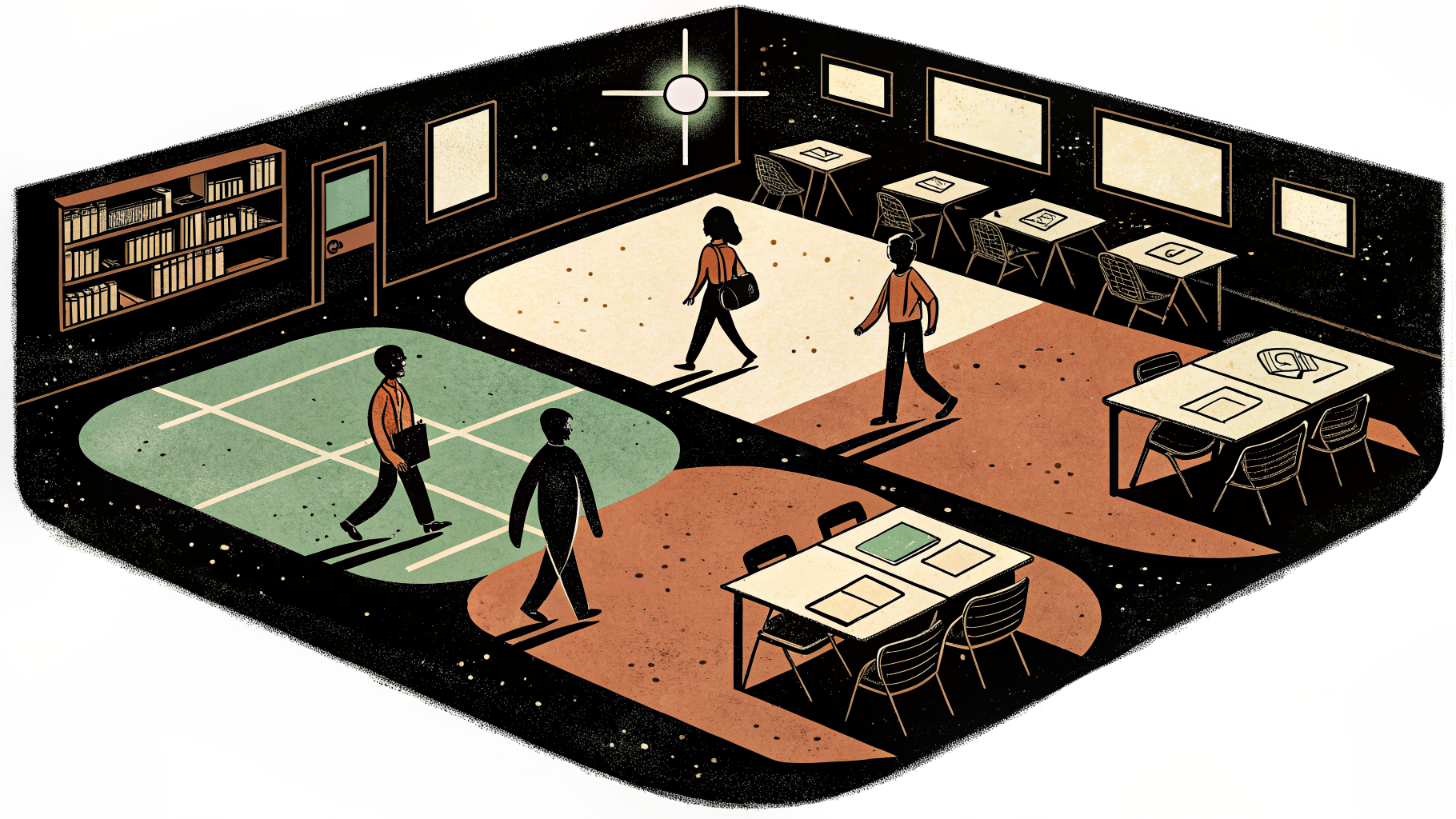
Ask most UK teachers what changed most in their classroom over the past decade, and few will say the curriculum. They'll say the pupils. Attention spans, motivation, willingness to sit and absorb a 40-minute explanation — all of it has shifted. Student centred learning isn't a new idea, but the pressure to use it well has never been higher.
The evidence, though, is genuinely complicated. And if you're trying to implement SCL while keeping exam results strong and satisfying an Ofsted inspector, you need a clearer picture than most teacher CPD sessions provide.
What is student centred learning in the UK context?
Student centred learning (SCL) places the pupil, rather than the teacher or the syllabus, at the heart of the learning process. Pupils are active participants in constructing knowledge, not passive recipients of it.
The theoretical roots lie in constructivism, particularly the work of Jean Piaget and Lev Vygotsky. Piaget argued that learners build understanding by connecting new experiences to existing schemas; Vygotsky added the social dimension, showing that learning happens most effectively within the Zone of Proximal Development — the space between what a pupil can do alone and what they can do with support. Both frameworks underpin what good SCL looks like in practice.
In UK schools, this often means moving away from the "sage on the stage" model (where the teacher talks and pupils listen) toward a facilitative role where the teacher designs experiences, asks probing questions, and guides rather than dictates. Across Key Stages, this can look very different: a Year 2 class exploring a science question through hands-on investigation; a Year 10 group leading their own research project before presenting findings to peers.
In England, "personalised learning" has frequently been applied at Key Stage 4 through expanded vocational pathways — BTECs, T Levels, and creative routes alongside GCSEs. This is one institutional expression of student centred principles: matching learning to the individual rather than forcing all pupils through a single academic mould.
Student centred vs. teacher-led instruction
The debate between teacher-led and pupil-led approaches is real, and it has data on both sides. Ignore either camp and you'll make a worse decision.
The case for explicit, teacher-led instruction is strong.John Hattie's synthesis of over 50,000 studies, published in Visible Learning, consistently identifies direct instruction, feedback, and teacher clarity among the highest-effect interventions. PISA data reinforces this: across OECD countries, higher levels of teacher-directed instruction correlate with significantly better performance in science assessments. This is not a marginal finding.
The 2015 PISA science report found that in most countries, pupils who experienced mostly inquiry-based teaching scored lower than those who received a mix of teacher-directed and inquiry approaches. The takeaway is not "abandon SCL" — it's "don't abandon structure."
Yet teacher-led instruction alone doesn't develop the capacity for independent thinking that pupils need beyond school. Research from OxfordAQA identifies critical thinking, problem-solving, collaboration, and independence as core outcomes of well-implemented SCL — skills that direct instruction rarely exercises directly.
The honest answer is that the binary framing is wrong. The most effective classrooms use teacher-led instruction to build knowledge and skill, then create structured opportunities for pupils to apply, extend, and question that knowledge independently. SCL doesn't replace good teaching; it extends it.
— Constructivist learning theory (Vygotsky, 1978)"What a child can do with assistance today, she will be able to do by herself tomorrow."
8 practical strategies for the modern UK classroom
These eight approaches can be introduced gradually. You don't need to redesign your whole curriculum — start with one, in one unit, and build from there.
1. Inquiry-based learning cycles
Give pupils a question rather than an answer.A structured inquiry cycle (question, research, hypothesise, test, reflect) works well across Key Stage 3 science, geography, and humanities. Crucially, the teacher designs the question and provides the scaffolding; pupils control the investigation route.
2. Project-based learning (PBL)
PBL anchors learning to a real-world problem or product. A Year 9 class designing a local transport solution, or a Year 5 class producing a school newspaper, builds subject knowledge while developing collaboration and communication. Keep projects time-bounded and include explicit knowledge checkpoints to avoid the "busy but not learning" trap.
3. Socratic seminars
Replace whole-class Q&A with a facilitated discussion where pupils question each other. The teacher sets the text, poses an opening question, and steps back. This works particularly well for English, PSHE, and RE, and builds the oracy skills Ofsted increasingly looks for.
4. Pupil choice in assessment
Offer structured choice: pupils can demonstrate understanding through a written essay, a presentation, a model, or a short film. The knowledge criteria stay fixed; the expression method varies. This small shift increases ownership without sacrificing rigour.
5. Think-pair-share with accountability
A simple but underused technique. Pose a question, give 90 seconds of individual thinking time, then structured paired discussion, then cold-calling for whole-class sharing.The accountability element, knowing they will be asked, keeps pupils genuinely engaged rather than letting a partner do the work.
6. Flipped learning
Pupils engage with new content (a short video, a reading) before the lesson; class time is used for application, discussion, and teacher-supported practice. This model, central to Flip Education's approach, maximises the high-value interaction time between teacher and pupil.
7. Learning menus and tiered tasks
Rather than one task for all, provide a tiered menu: a foundational task, an extension task, and a challenge task. Pupils self-select or are guided by the teacher. This structures autonomy within clear boundaries — critical for mixed-ability classes.
8. Flexible classroom arrangements
Physical space shapes interaction in student-centred learning environments.Even simple changes, like moving desks from rows to clusters for collaborative tasks and back again for direct instruction, signal to pupils that the mode of learning is changing.
Supporting SEND and neurodivergent learners through SCL
This is where SCL implementation most often goes wrong. The assumption that greater autonomy benefits all pupils equally is not supported by evidence.
Pupils with weaker self-regulation, less developed working memory, or limited background knowledge tend to struggle disproportionately in unstructured learning environments. For pupils with EHCPs, autism spectrum conditions, dyslexia, or ADHD, an open-ended project without clear milestones and explicit instruction can generate anxiety rather than engagement.
The solution is not to exclude these pupils from SCL, but to scaffold it properly.
For pupils with EHCPs: Map SCL activities against EHCP targets. If a pupil's EHCP includes targets around social communication, a Socratic seminar with a structured speaking frame directly supports that target. Make the connection explicit with SENCOs.
For pupils with dyslexia or processing differences: Provide instructions in multiple formats — verbal, written, visual. Break tasks into clearly sequenced steps with checkpoints. Allow extended processing time before pair or grFor pupils with ADHD: Short, varied task cycles with clear start and end points work better than extended open-ended projects. Offer movement breaks within the task structure. Use visual timers.
For pupils from disadvantaged backgrounds: Pupils with less cultural and academic capital tend to need more teacher input, not less, within SCL frameworks. Pre-teaching key vocabulary and concepts before an inquiry task ensures these pupils can participate fully rather than spending the task catching up.
Build the scaffold first, then gradually remove it. SCL's goal is independent, self-directed learning — but independence is a destination, not a starting point. Pupils with additional needs often need a longer, more explicit journey to get there.
Measuring the impact on Ofsted outcomes and exam performance
The question every department head wants answered is simple: will this affect our results?
The honest answer depends heavily on how SCL is implemented.Poorly designed open-ended learning, where pupils are active but not actually acquiring knowledge, will hurt performance on GCSEs and A-levels that require precise, retrievable knowledge. Well-designed SCL, where pupil activity is anchored to curriculum content and includes regular retrieval practice, can improve both.
Ofsted's Quality of Education judgement
Ofsted's current inspection framework does not prescribe a teaching style. The 'Quality of Education' judgement focuses on three components: curriculum intent, implementation, and impact. SCL can score well on all three, but only if the intent is clearly articulated.
Inspectors will ask: does the curriculum build knowledge sequentially? Are pupils making progress? Can pupils talk about what they've learned and why it matters?A well-implemented SCL approach, where pupils have genuinely wrestled with ideas, made connections, and developed understanding rather than surface-level familiarity, tends to produce pupils who can answer these questions confidently.
The weakness inspectors commonly find in SCL classrooms is a lack of curriculum coherence: activities that are engaging but disconnected, or where the teacher cannot clearly explain what knowledge pupils are building and in what sequence. Address this by mapping every SCL activity back to specific curriculum objectives and checking explicitly for knowledge retention, not just task completion.
Exam performance
When student-centred approaches increase intrinsic motivation and connect learning to real-world contexts, pupils tend to engage more deeply with subject content. Deeper engagement supports long-term retention — which is what exams test.
The optimal model for most UK secondary classrooms is adeliberate blend: teacher-led instruction to introduce and build knowledge, then structured SCL activities to apply, extend, and consolidate it. Neither approach alone is sufficient. The PISA data is a warning against over-indexing on inquiry at the expense of knowledge acquisition, not a case against pupil-led learning altogether.
What this means for your classroom
Student centred learning works. The evidence on motivation, critical thinking, and collaborative skills is consistent. But it works best when the teacher remains actively present — designing the conditions for learning, providing explicit instruction where it's needed, and scaffolding the transition to independence carefully.
For UK teachers navigating the Ofsted framework, curriculum sequencing demands, and the diverse needs of their pupils, the practical path forward is clear. Don't choose between teacher-led and student centred learning. Build direct instruction and active inquiry into the same sequence. Give pupils genuine agency within structured boundaries. And pay particular attention to pupils who need more scaffolding, not less, to benefit from that agency.
Student centred learning at its best doesn't reduce the teacher's importance. It increases the sophistication of what teaching requires.