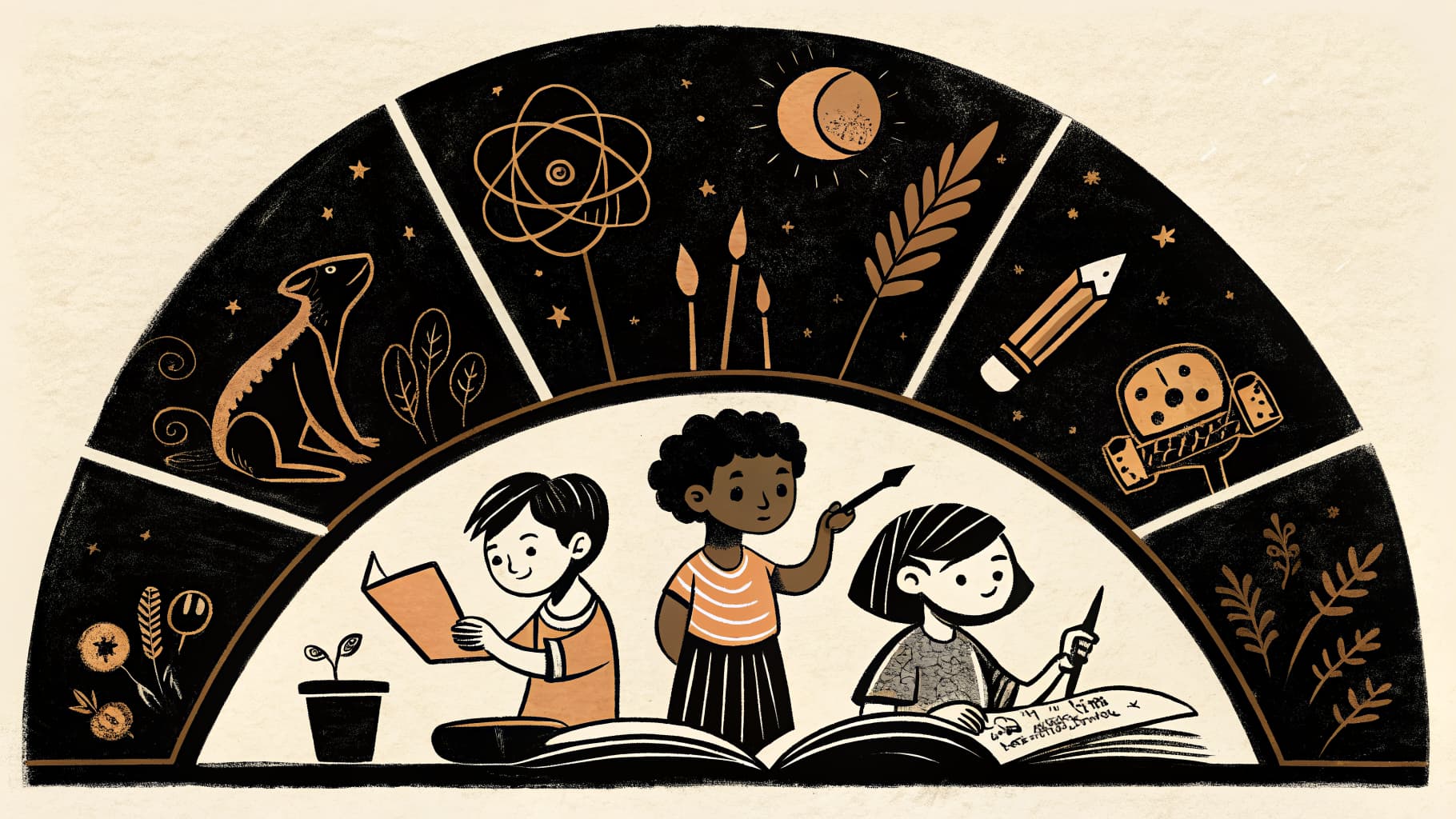
Re-represent one concept across 2-3 child-chosen "languages" (clay, paint, body, sound)
Hundred Languages
Teacher introduces a single concept orally; children re-represent it across 2-3 "languages" of their choice from a curated menu (drawing, paint, clay, fingerpaint, scarves for movement, music sticks, blocks, collage). After 12-15 minutes of creating, children share briefly. Honors Malaguzzi's principle that there are 100 (and 100, and 100 more) ways to express an idea. Never critique or "fix" a child's representation. Adapted from Reggio atelier practice for a 20-minute single-class format.
What is Hundred Languages?
The Hundred Languages of Children is not just a teaching method; it is a philosophy of childhood that originated in the city of Reggio Emilia, Italy. At its heart is the belief that children are born with a vast array of ways to express themselves, communicate, and understand the world. Loris Malaguzzi, the founder of this approach, famously wrote that the child has a hundred languages, but the traditional school system 'steals ninety-nine' by focusing almost exclusively on verbal and written communication (Malaguzzi, 1993). In a Hundred Languages classroom, we work to protect and celebrate all those ways of being.
For children aged 3 to 6, the world is experienced through the senses. They do not yet have the fluency to write down their theories about how a seed grows or why the sun moves. However, they can show us these theories through the way they mold clay, the way they arrange blocks, or the way they move their bodies in a dance. This multi-modal approach is essential for cognitive development. When a child explores the same concept through different materials, they are forced to think about that concept in new ways. Each new language adds a layer of complexity to the child's mental model.
Central to this practice is the 'atelier,' or workshop space. As documented by Vecchi (2010), the atelier is a place where children have access to a wide variety of expressive tools, often supported by the atelierista, a specialist teacher who helps deepen these creative investigations. It is not just an art room; it is a laboratory for thinking. In this space, the teacher acts as a 'co-researcher.' This means the teacher is not there to give answers, but to observe the children's inquiries. If a teacher sees a group of children fascinated by the shadows on the playground, they might bring that interest back into the classroom. They might start by offering black paper and white chalk (the first language). After observing the children's drawings, the teacher might then set up a light projector and loose parts (the second language) to see how the children explore the transparency and movement of those shadows.
Documentation is the thread that holds these languages together. Because we treat these expressions as serious research, we must record them. This involves taking photographs of the work in progress, recording the children's conversations, and keeping their physical creations. This documentation serves three purposes. First, it makes the children's learning visible to the children themselves, allowing them to reflect on their own growth. Second, it helps teachers understand the children's thinking so they can plan the next 'language' to offer. Third, it communicates the value of early childhood education to parents and the community, showing that play is actually deep, intellectual work.
In a Hundred Languages environment, we do not use worksheets or pre-cut crafts. We believe that children are competent and capable of handling real materials. We offer them high-quality paints, real clay, and natural materials like stones and leaves. By treating the children's work with this level of respect, we foster a sense of agency and confidence. The goal is not to produce artists, but to produce thinkers who know that they have many ways to make their voices heard. As Malaguzzi (1993) reminded us, the hundred is there, and our job is to ensure it remains a part of every child's life.
How to Run Hundred Languages: Step-by-Step
Identify a spark
4 min
Observe the children at play to find a concept they are curious about, such as how water flows or how birds fly.
Offer the first language
3 min
Provide a simple medium like charcoal or pencils for children to draw or mark-make their initial observations about the spark.
Document the process
3 min
Take photos and write down exactly what the children say and do as they work with the material.
Analyze and pivot
4 min
Review your notes to see what the children are struggling with or excited about, then choose a second medium that offers a new perspective.
Introduce a contrasting medium
4 min
If they drew something flat, offer clay or wire to help them explore the same idea in three dimensions.
Connect the languages
4 min
Show the children their previous work alongside their new work to help them see the trajectory of their own thinking.
BEFORE YOU TEACH THIS
Read the Teacher's Guide first.
Flip Education's Teacher's Guide walks you through how to facilitate any active learning lesson: mindset, pre-class checklist, phase-by-phase facilitation, and a Quick Reference Card you can print and bring to class.
Read the Teacher's Guide →When to Use Hundred Languages in the Classroom
- Topics with no single right answer (wonder, observation, feeling)
- Children who think in images, body, or sound more than words
- Bridging concept and creative expression
- Building children's sense that all forms of expression are valued
Research Evidence for Hundred Languages
Robson, K., Mastrangelo, S. (2018, Journal of Childhood Studies, 42(4), 1-16)
Qualitative study of kindergarten children in a Reggio-inspired school. Children described how multi-modal materials in the classroom (clay, paint, blocks, light tables) supported their pretend play, peer communication, and connections to real-life experience. Validates the hundred-languages design principle that varied media expand expressive range.
Hewett, V. M. (2001, Early Childhood Education Journal, 29(2), 95-100)
Peer-reviewed examination of Reggio Emilia practice including the role of the atelier and the multi-modal expression strategies that comprise the hundred-languages curriculum.
The Hundred Languages has no dedicated RCT evidence base, partly by design: Reggio Emilia explicitly resists standardised outcome measurement. The peer-reviewed work above examines the practice qualitatively rather than measuring downstream test scores.
Principles and Practice of Hundred Languages
Malaguzzi, L. (1993, In Edwards, Gandini, Forman (Eds.), The Hundred Languages of Children, Ablex Publishing)
Presents the foundational poem of the Reggio Emilia approach. The child is described as having a hundred languages of expression, against a school that risks stealing ninety-nine of them.
Vecchi, V. (2010, Routledge, Contesting Early Childhood Series)
Documents the role of the atelier and the atelierista in Reggio practice, showing how multi-modal expression (drawing, clay, light, shadow, movement) extends the languages available to the child.
Common Hundred Languages Mistakes and How to Avoid Them
Treating materials as simple crafts
If you focus only on the final product looking pretty, the child stops thinking and starts following directions. Focus instead on the child's choices and what they are trying to communicate.
Leading the child too much
Teachers often want to show the 'right' way to use clay or wire. Step back and let the child discover the properties of the material themselves, only stepping in to demonstrate a specific technique if they ask , for example, showing how to score and slip clay to join two pieces, or how to bend wire without it snapping.
Ignoring the child's verbal comments
A child's words are just as important as their drawings. If you do not record their stories and explanations, you miss half of the 'hundred languages' they are using.
Moving too fast between steps
Children need time to revisit the same idea over several days. Do not rush to the next material before the child has fully exhausted their interest in the current one.
Privileging writing over other forms
In early years, we often value letters and numbers most. Remember that a dance or a block tower is a serious way of expressing a complex thought for a four year old.
How Flip Education Helps
Observation Grid Generator
Flip Education creates structured grids for teachers to quickly jot down child quotes and actions during multi-modal sessions. This helps keep documentation organized without taking the teacher away from the interaction.
Picture-Based Reflection Prompts
The system generates simple cards with icons that prompt children to think about their work. For example, a card with a 'magnifying glass' might prompt a child to look closer at a detail in their clay model.
Material Sequence Day-Plans
Flip Education provides visual schedules for the classroom wall that show the progression of languages. These strips use pictures of clay, watercolors, wire, and a light table to help children see the journey of their project.
Visual Provocation Cards
The platform generates high-quality images of natural objects or simple shapes to spark initial curiosity. These cards serve as the 'first language' to get the conversation started in a group circle.
Tools and Materials Checklist for Hundred Languages
- Natural clay and basic sculpting tools
- Charcoal sticks and various weights of paper
- Light table or overhead projector
- Loose parts like stones, buttons, and wire
- Digital camera for teacher documentation
- Transparent and opaque fabrics
- Watercolors and high-quality brushes
Frequently Asked Questions About Hundred Languages
Is this just an art project?
No, it is a way of thinking. While children use art materials, the goal is to help them explore a concept like 'shadows' or 'friendship' through different lenses.
How long should each session last?
Plan for 30 to 60 minutes per language step. Some children may need more time to settle into a material, while others might move quickly.
Do I need to be an artist to teach this?
Not at all. Your role is to be a co-researcher who provides the materials and observes how the children use them to solve problems.
What if a child only wants to use one material?
That is okay. You can gently invite them to try a new medium by showing how it might reveal something different about their favorite topic.
How do I know if they are learning?
Look at your documentation. When you see a child translate a drawing into a clay sculpture, you are seeing their brain make new connections.
Classroom Resources for Hundred Languages
Free printable resources designed for Hundred Languages. Download, print, and use in your classroom.
Teacher Inquiry Prompts
A list of open-ended questions to use while children are working with different materials.
Download PDFMy Thinking Journey
A picture-based reflection tool for children to use at the end of a project.
Download PDFCollaborative Language Card
A guide for teachers to support social-emotional learning during group projects.
Download PDFDocumentation Map
A simple layout for teachers to organize photos and quotes from a multi-day exploration.
Download PDFRelated
Methodologies Similar to Hundred Languages
Ready to try this?
- Read the Teacher's Guide →
- Generate a mission with Hundred Languages →
- Print the toolkit after generating
Generate a Mission with Hundred Languages
A complete lesson plan, aligned to your curriculum.