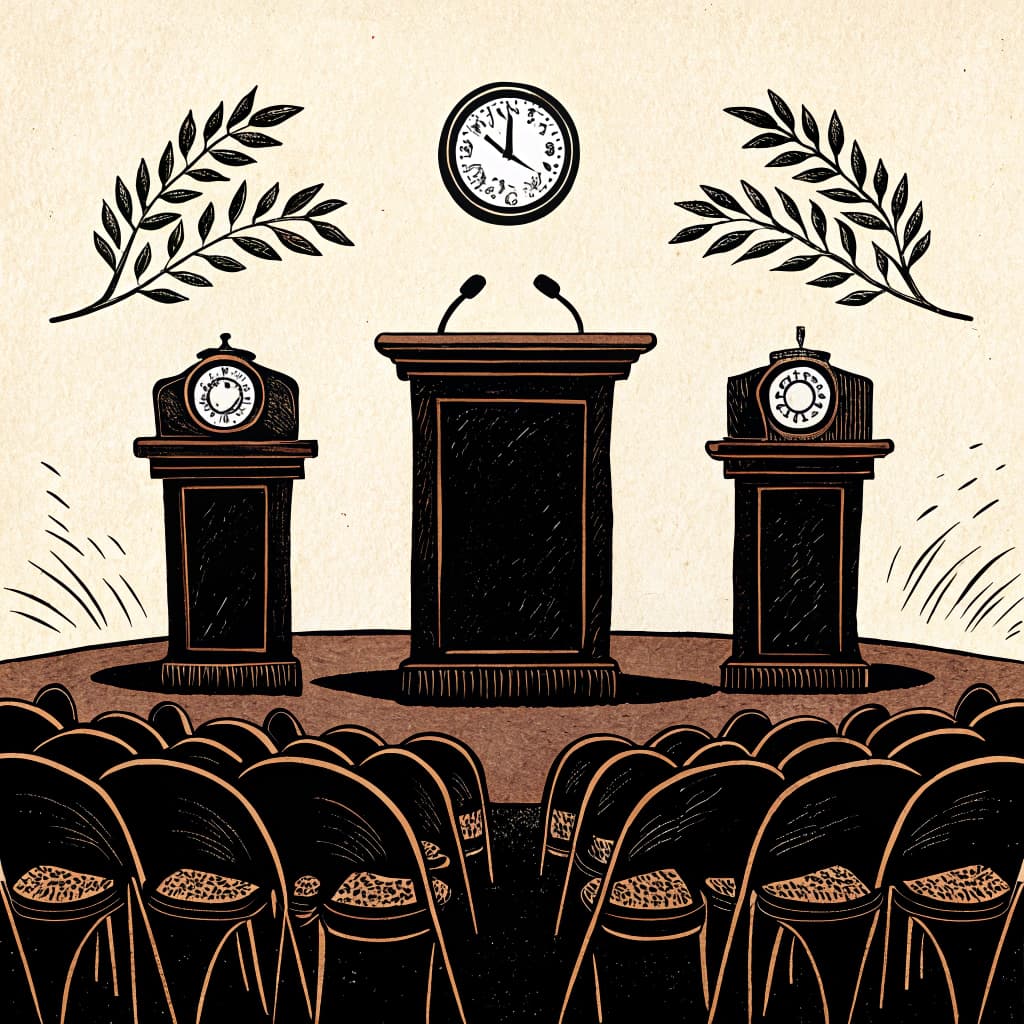
Structured argumentation with timed speeches
Formal Debate
Two teams prepare and deliver structured arguments for and against a proposition. Each side presents opening statements, rebuttals, and closing arguments within strict time limits. The rest of the class evaluates arguments using a rubric. Develops research skills, logical reasoning, public speaking, and the ability to anticipate counterarguments.
What is Formal Debate?
Debate has been a formal educational methodology since ancient Greece, where rhetoric (the art of persuasive argument) was considered one of the central disciplines of an educated person. The medieval university codified formal disputation as a standard academic practice: students were expected to argue both sides of a proposition as a demonstration of philosophical and logical mastery. Modern school debate, with its competitive format, structured time limits, and judging criteria, emerged in the late 19th and early 20th centuries as extracurricular competition before becoming a widely-used classroom methodology.
The educational value of formal debate extends well beyond the surface skill of public speaking. Research consistently shows that preparing to argue a position, gathering evidence, organizing arguments, anticipating counterarguments, developing rebuttals, produces deep understanding of the content behind the debate. Students who have argued both sides of the question "Was the New Deal good for America?" understand American economic history more deeply than students who have read the same material for a test. The argumentative pressure of debate forces engagement with the content at a level of specificity and critical scrutiny that passive study rarely achieves.
The assignment of positions is a feature, not a bug, of classroom debate, though it is often experienced as the latter. Being required to argue a position you don't personally hold is an exercise in intellectual discipline and perspective-taking. The student who must argue that the Treaty of Versailles was justified has to understand the post-WWI context, the political pressures on Allied governments, and the arguments made at the time, regardless of their own contemporary assessment. This required perspective-taking is one of the method's most valuable pedagogical properties.
Cross-examination is the phase of debate that most directly develops the skill of responding to opposing arguments under pressure. In formal debate, cross-examination periods require debaters to engage directly with specific claims the opposing team has made: not to score rhetorical points, but to expose weaknesses in the argument's evidence or logic. This skill, identifying and articulating the specific weakness in a specific argument, is among the most transferable in academic discourse and professional life.
The audience, whether a small judging panel or a full classroom, is not merely spectators in a well-designed classroom debate. Structured audience roles keep observers intellectually active: scoring speakers on specific criteria, drafting their own counterarguments, identifying the most compelling piece of evidence presented, or preparing the question they would most like to ask during cross-examination. These audience tasks transform debate from a performance for passive witnesses into a collaborative intellectual exercise.
The post-debate debrief is where the content learning consolidates. The most productive debrief moves beyond "who won?" to examine the substantive questions the debate raised: Which pieces of evidence were strongest and why? Which arguments would require more research to properly evaluate? What aspects of the topic remain genuinely unresolved? Where did both sides agree, despite their surface disagreement? These questions return attention to the content and the intellectual complexity of the topic, the reason the debate was worth having in the first place.
How to Run Formal Debate: Step-by-Step
Select a Binary Resolution
7 min
Choose a clear, debatable statement (e.g., 'Resolved: Artificial Intelligence does more harm than good') that aligns with your current unit of study.
Assign Teams and Roles
6 min
Divide the class into Affirmative and Negative teams, and assign specific roles such as lead speaker, rebuttal specialist, and researcher.
Conduct Evidence-Based Research
6 min
Provide students with dedicated time to gather facts, statistics, and expert testimony from credible sources to support their assigned position.
Draft Argument Outlines
7 min
Instruct teams to organize their findings into a logical flow, including an introduction, three main points of contention, and a conclusion.
Execute the Formal Debate
7 min
Facilitate the debate using a timer, allowing each side to present their opening case, followed by a cross-examination or rebuttal period.
Facilitate a Whole-Class Reflection
7 min
Lead a post-debate discussion where students step out of their roles to analyze which arguments were most effective and why.
BEFORE YOU TEACH THIS
Read the Teacher's Guide first.
Flip Education's Teacher's Guide walks you through how to facilitate any active learning lesson: mindset, pre-class checklist, phase-by-phase facilitation, and a Quick Reference Card you can print and bring to class.
Read the Teacher's Guide →When to Use Formal Debate in the Classroom
- Controversial historical decisions
- Policy comparisons across eras
- Evaluating causation vs. correlation
- Building argumentation skills
Subject Fit
Common variants
Formal structured debate
Defined sides, timed speeches, rebuttal rounds. Good for a capstone where you want to see argument construction under constraint.
Rolling debate
Students move back and forth across the room as their position shifts; speakers argue from wherever they currently stand. Makes persuasion visible as physical movement.
Silent written debate
Teams pass a shared document back and forth, writing claims and rebuttals in turn. Pressure-free for anxious speakers and produces a written record for review.
Research Evidence for Formal Debate
Omelicheva, M. Y., & Avdeyeva, O. (2008, PS: Political Science & Politics, 41(3), 603-607)
The study provides empirical evidence that classroom debates have a more positive impact on students' critical thinking and academic attainment than traditional lecture formats.
Roy, A., & Macchiette, B. (2005, Journal of Marketing Education, 27(3), 264-276)
This research shows that debate serves as a powerful pedagogical tool for enhancing analytical skills by requiring students to rigorously investigate and synthesize complex information.
Common Formal Debate Mistakes and How to Avoid Them
Students stuck defending positions they don't believe
Assigned positions can produce hollow arguments. One way around this: tell students their assignment only after they've spent time researching both sides. Another: explicitly discuss the value of steelmanning, making the strongest possible case for a position regardless of personal belief.
Preparation time that's too short
Students who walk into a debate underprepared speak in vague generalities and get shut down by specific evidence from the other side. Debate requires substantive research time, at least 2-3 class periods, and a structured preparation template: claim, evidence, counterargument, rebuttal.
No criteria for audience evaluation
When audience members have no framework for assessing arguments, they default to judging by confidence or volume. Give audience members a scoring guide: Did the speaker cite specific evidence? Did they address the opposing argument directly? Was the reasoning logically sound?
Cross-examination that becomes personal
Young debaters especially can let cross-examination slide into personal criticism. Pre-teach the distinction: attack the argument, not the person. Establish a clear norm and be ready to pause and redirect if the line gets crossed.
Forgetting the content behind the debate
The debate format can become an end in itself, with students focused on 'winning' rather than engaging with course content. Design debrief questions that return to the underlying material: What did this debate reveal about [the historical event / scientific question / ethical dilemma]?
How Flip Education Helps
Printable position cards and argument scaffolds
Flip generates printable position cards for each side of the debate, along with scaffolds to help students structure their arguments and rebuttals. These materials provide the necessary evidence and talking points for a single-session activity. Everything is formatted for immediate printing and distribution.
Standards-based debate topics for any subject
The AI creates a debate topic that is directly aligned with your curriculum standards and appropriate for your grade level. The activity is designed to fit into a 20-60 minute period, focusing on key concepts within your lesson. This ensures the debate is a rigorous academic exercise.
Facilitation script and numbered debate steps
Follow the generated script to brief students on the debate format and use numbered action steps to manage the timing of each round. The plan includes teacher tips for maintaining order and intervention tips for helping students who struggle to articulate their points. This guide keeps the debate productive.
Reflection debrief and exit tickets for closure
End the debate with discussion questions that ask students to reflect on the strengths of each side's arguments. A printable exit ticket is included to assess individual understanding of the curriculum content. The generation concludes with a link to the next lesson in your unit.
Tools and Materials Checklist for Formal Debate
- Timer (digital or physical)
- Rubrics for argument evaluation
- Whiteboard or projector for displaying proposition/rules
- Research materials (textbooks, articles)
- Note-taking supplies for debaters and audience
- Digital research databases (optional)
- Online collaborative document tools (e.g., Google Docs) (optional)
- Microphones (for larger groups/spaces) (optional)
Frequently Asked Questions About Formal Debate
What is Formal Debate in education?
Formal debate is a structured pedagogical tool where students present opposing arguments on a specific topic following a set of rules and time limits. It is designed to foster critical thinking, public speaking, and evidence-based reasoning in a classroom setting.
How do I use Formal Debate in my classroom?
Start by selecting a controversial, binary topic related to your curriculum and assign students to 'pro' or 'con' teams regardless of their personal beliefs. Provide a clear rubric and time structure for opening statements, rebuttals, and closing arguments to ensure a fair and organized process.
What are the benefits of Formal Debate for students?
The primary benefits include improved analytical thinking, enhanced research skills, and increased confidence in oral communication. It also promotes empathy and perspective-taking as students are often required to argue for positions they do not personally hold.
How do you assess a classroom debate?
Assessment should be based on a rubric that evaluates the use of evidence, logical consistency, delivery style, and the quality of rebuttals. Teachers can also include a peer-review component where the audience evaluates the persuasiveness and factual accuracy of each team.
Classroom Resources for Formal Debate
Free printable resources designed for Formal Debate. Download, print, and use in your classroom.
Debate Preparation Organizer
Students build their argument by organizing their position, supporting evidence, anticipated counterarguments, and planned rebuttals before the debate begins.
Download PDFPost-Debate Reflection
Students evaluate their own performance, the strength of arguments on both sides, and what they learned from engaging with the opposing position.
Download PDFDebate Role Cards
Assign roles so every student has a clear purpose during the debate, whether speaking, researching, or evaluating.
Download PDFDebate Prompt Bank
Ready-to-use prompts that guide students through every phase of a structured classroom debate.
Download PDFSEL Focus: Self-Management in Debate
A card focused on emotional regulation and composure during the high-energy environment of a classroom debate.
Download PDFRelated
Methodologies Similar to Formal Debate
Ready to try this?
- Read the Teacher's Guide →
- Generate a mission with Formal Debate →
- Print the toolkit after generating
Generate a Mission with Formal Debate
A complete lesson plan, aligned to your curriculum.