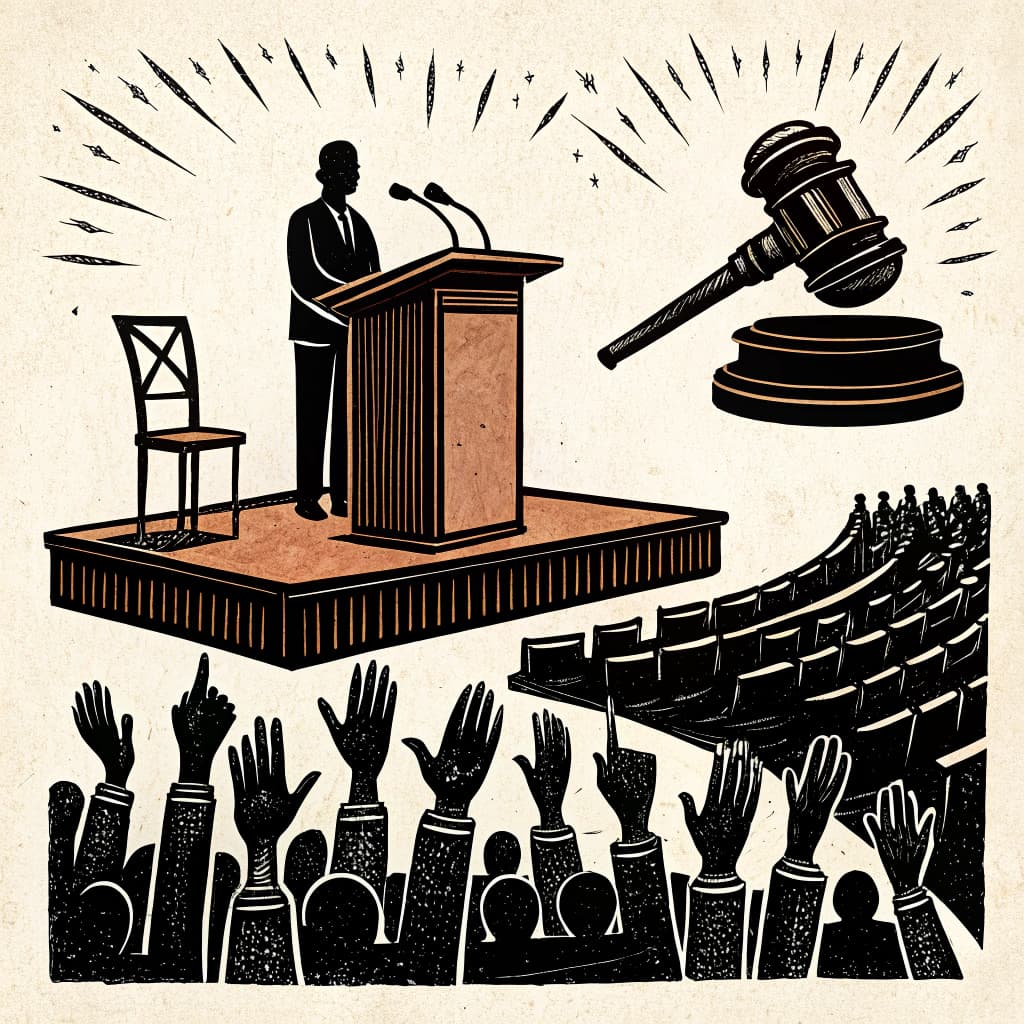
Community meeting simulation with stakeholder roles
Town Hall Meeting
Students take on roles as community members, officials, or stakeholders and participate in a structured town hall meeting about a controversial issue. A moderator (student or teacher) manages speaking time. Each stakeholder presents their position, takes questions, and responds to others. The class votes or reaches a decision at the end.
What is Town Hall Meeting?
The Town Hall meeting is one of the oldest democratic deliberation formats in North American civic history, dating to colonial New England, where direct community governance was practiced in formal gatherings where all community members could speak and vote. The classroom methodology adapts this format for academic learning: students take on stakeholder roles, deliberate over a specific issue, and work toward a community decision or position. The format is explicitly civic in its purpose, developing the deliberative skills and habits of mind that democratic participation requires, while simultaneously being a vehicle for deep content learning about the topic under deliberation.
The stakeholder role card is the pedagogical core of the Town Hall format. A good stakeholder card gives each participant a specific identity, a set of genuine interests connected to that identity, a set of constraints on what they can accept, and a set of evidence or arguments they can draw on. These role cards create conditions where students must think within a perspective rather than simply asserting their own view, and the experience of inhabiting a different perspective, even briefly, is one of the most powerful tools education has for developing genuine understanding of complexity.
Genuine conflict between stakeholders, interests that cannot all be satisfied simultaneously, is what makes the Town Hall format educationally productive rather than simply theatrical. A Town Hall where all stakeholders can be satisfied by the same policy is not a Town Hall; it's a planning meeting. The productive Town Hall requires students to wrestle with the irreducible tensions in real policy: environmental protection versus economic development, individual rights versus collective welfare, short-term costs versus long-term benefits. These tensions don't resolve cleanly, and the deliberative process of working through them, finding what can be compromised and what cannot, is the form of reasoning that citizenship requires.
The facilitation challenge in Town Hall is maintaining a space where all stakeholders can be heard without any single stakeholder dominating. Strong personalities, high-status students, and students who have done the most preparation tend to dominate facilitated discussions unless the facilitation explicitly creates space for all voices. Structured speaker protocols, each stakeholder must address the group at least once before anyone speaks twice, each stakeholder must respond specifically to a point made by a different stakeholder before making a new claim, distribute the speaking and the listening more equitably.
The resolution phase, bringing the Town Hall to some kind of decision or at least a structured accounting of agreements and disagreements, is what gives the deliberative process its civic dimension. Even when genuine consensus is impossible, the practice of drafting a policy statement that acknowledges competing interests and explains the basis for the decision made is a sophisticated civic skill. Students who practice this formal deliberative writing are developing capacity for democratic participation that extends well beyond the classroom.
The debrief of a Town Hall, stepping out of character roles and analyzing what the deliberation revealed, is where the content learning consolidates. Questions that move from the simulation to the underlying content are the most valuable: "What did this Town Hall reveal about the actual challenges facing [the real policy issue / historical decision / contemporary controversy]? Whose voice was missing from our Town Hall that would have changed the deliberation? What would real stakeholders in this situation need to know that our role cards didn't give them?" These questions connect the dramatic experience to academic understanding.
How to Run Town Hall Meeting: Step-by-Step
Select a Compelling Issue
6 min
Choose a controversial, multi-sided topic relevant to your curriculum that has no single 'right' answer, such as a local zoning law or a historical policy decision.
Assign Stakeholder Roles
6 min
Distribute roles to students representing diverse interests, including community members, experts, government officials, and affected minority groups.
Conduct Evidence-Based Research
6 min
Provide time for students to research their assigned role's perspective, requiring them to find at least three pieces of evidence to support their likely testimony.
Prepare Opening Statements
7 min
Have each stakeholder group draft a concise 2-minute speech outlining their position and their specific 'asks' or recommendations for the town council.
Facilitate the Public Hearing
7 min
Arrange the room in a semi-circle and have the 'Town Council' or moderator call on stakeholders to present their testimony and answer questions from the floor.
Deliberate and Vote
7 min
Allow the decision-making body to deliberate publicly before casting a final vote on the resolution or proposed policy change.
Debrief and Reflect
6 min
Lead a whole-class discussion where students step out of their roles to analyze which arguments were most persuasive and how the process felt.
BEFORE YOU TEACH THIS
Read the Teacher's Guide first.
Flip Education's Teacher's Guide walks you through how to facilitate any active learning lesson: mindset, pre-class checklist, phase-by-phase facilitation, and a Quick Reference Card you can print and bring to class.
Read the Teacher's Guide →When to Use Town Hall Meeting in the Classroom
- Local vs. global decision-making
- Understanding stakeholder perspectives
- Civic engagement and democratic processes
- Connecting historical events to modern parallels
Subject Fit
Common variants
Issue town hall
Students take constituency roles and debate a single policy question with a neutral moderator. Works well as the capstone of a civics unit.
Panel-plus-questions town hall
A panel of role-holders answers questions from a citizen audience (the rest of the class). The audience role is active because they prepared the questions.
Research Evidence for Town Hall Meeting
Kahne, J., Crow, D., & Lee, N. J. (2012, Political Psychology, 34(3), 419-441)
Interactive civic learning opportunities, including simulations and discussions of civic issues, significantly increase students' later political engagement and efficacy.
Avery, P. G., Levy, B. L. M., & Simmons, A. M. M. (2013, The Social Studies, 104(3), 105-114)
Engaging in structured deliberations on public issues increases students' civic competence and their willingness to participate in community decision-making.
Common Town Hall Meeting Mistakes and How to Avoid Them
Students who haven't researched their roles
Town Hall collapses if participants can't articulate a specific, evidence-based position. Require written role preparation submitted before class: who they are, what they want, what evidence supports their position, and what they're willing to compromise on.
Facilitator who takes a position
The facilitator's job is to surface all perspectives, not advocate for one. If you as teacher-facilitator show preference for certain arguments, participants adjust their contributions to please rather than genuinely represent their assigned stakeholder. Stay neutral and procedural.
Not including genuine conflict
A Town Hall where all participants basically agree is a group presentation, not a forum. Design role cards so stakeholders have genuinely incompatible interests. The productive tension between interests is where the learning lives.
No resolution or decision-making process
Town Halls that surface conflict without any resolution mechanism feel unfinished. Even if real consensus isn't reached, have participants vote on a policy, write a compromise statement, or identify the 'best available' option given the constraints. This decision-making step develops civic thinking skills.
Audience members without a task
Non-speaking participants disengage quickly. Give audience members structured roles: question drafters who prepare follow-up questions, reporters who must summarize each stakeholder's position, or fact-checkers who verify claims against provided evidence.
How Flip Education Helps
Printable stakeholder role cards and facilitator guides
Flip generates printable role cards for various stakeholders involved in a community issue and a detailed guide for the student facilitator. These materials provide the background and goals needed for a structured public meeting. Everything is formatted for quick printing and immediate use.
Topic-specific town hall scenarios aligned to standards
The AI creates a town hall scenario that is directly tied to your lesson topic and grade level, ensuring students explore multiple perspectives on a curriculum-related issue. The activity is designed for a single session, focusing on civic engagement and academic content. This alignment keeps the focus on your learning goals.
Facilitation script and numbered meeting steps
Use the provided script to brief students on the town hall format and follow numbered action steps for managing the stakeholder presentations and audience questions. The plan includes teacher tips for maintaining order and intervention tips for helping students stay in character. This guide helps you manage the meeting effectively.
Reflection debrief and exit tickets for closure
End the session with debrief questions that ask students to reflect on the different viewpoints and the difficulty of reaching a consensus. A printable exit ticket is included to assess individual understanding of the topic. The generation concludes with a link to your next classroom lesson.
Tools and Materials Checklist for Town Hall Meeting
- Assigned Role Cards/Briefs
- Podium or Designated Speaking Area
- Timer for Speaking Turns
- Whiteboard or Projector for Agenda/Key Points
- Voter Ballots (for decision-making) (optional)
- Research Materials (articles, data, historical documents)
- Microphone (for larger groups) (optional)
- Online Discussion Forum (for pre-discussion or post-reflection) (optional)
Frequently Asked Questions About Town Hall Meeting
What is a Town Hall Meeting in the classroom?
A Town Hall Meeting is a role-play simulation where students represent different community stakeholders to discuss and vote on a specific issue. It serves as an active learning strategy to teach civic engagement, public speaking, and multi-perspective analysis. Teachers use it to transform abstract curriculum topics into tangible, debated problems.
How do I assess student performance during a Town Hall Meeting?
Assessment should focus on the quality of evidence used during testimony and the alignment of the student's arguments with their assigned role. Use a rubric that evaluates research preparation, oral communication, and the ability to respond to cross-examination. You can also include a post-simulation reflection paper to assess individual content mastery.
What are the benefits of Town Hall Meeting for students?
The primary benefits include increased empathy, improved critical thinking, and the development of collaborative problem-solving skills. Students learn to see issues from diverse viewpoints, which reduces polarization and encourages evidence-based reasoning. It also provides a high-stakes, authentic audience for practicing persuasive writing and speaking.
How do I manage classroom behavior during a heated Town Hall debate?
Establish clear 'Rules of Civil Discourse' and appoint a student moderator to enforce time limits and speaking turns. Providing students with specific sentence stems for respectful disagreement can prevent personal attacks. The teacher should remain a neutral observer, only intervening if the established decorum is breached.
Can Town Hall Meetings be used for science or math topics?
Yes, they are highly effective for exploring socio-scientific issues like climate change policy, public health mandates, or land use ethics. In these contexts, students must use data and mathematical modeling to support their stakeholder's position. This demonstrates the real-world application of STEM concepts in public decision-making.
Classroom Resources for Town Hall Meeting
Free printable resources designed for Town Hall Meeting. Download, print, and use in your classroom.
Town Hall Preparation Sheet
Students prepare their position, supporting evidence, and potential counterarguments before the class town hall meeting.
Download PDFTown Hall Reflection
Students evaluate their participation in the structured class meeting and reflect on how the deliberative process shaped their views.
Download PDFTown Hall Meeting Roles
Assign formal roles to run the town hall meeting with structure and civic purpose.
Download PDFTown Hall Discussion Prompts
Structured prompts for each phase of a classroom town hall, from opening to deliberation.
Download PDFSEL Focus: Responsible Decision-Making
A card focused on civic reasoning and evidence-based deliberation during classroom town hall meetings.
Download PDFRelated
Methodologies Similar to Town Hall Meeting
Ready to try this?
- Read the Teacher's Guide →
- Generate a mission with Town Hall Meeting →
- Print the toolkit after generating
Generate a Mission with Town Hall Meeting
A complete lesson plan, aligned to your curriculum.