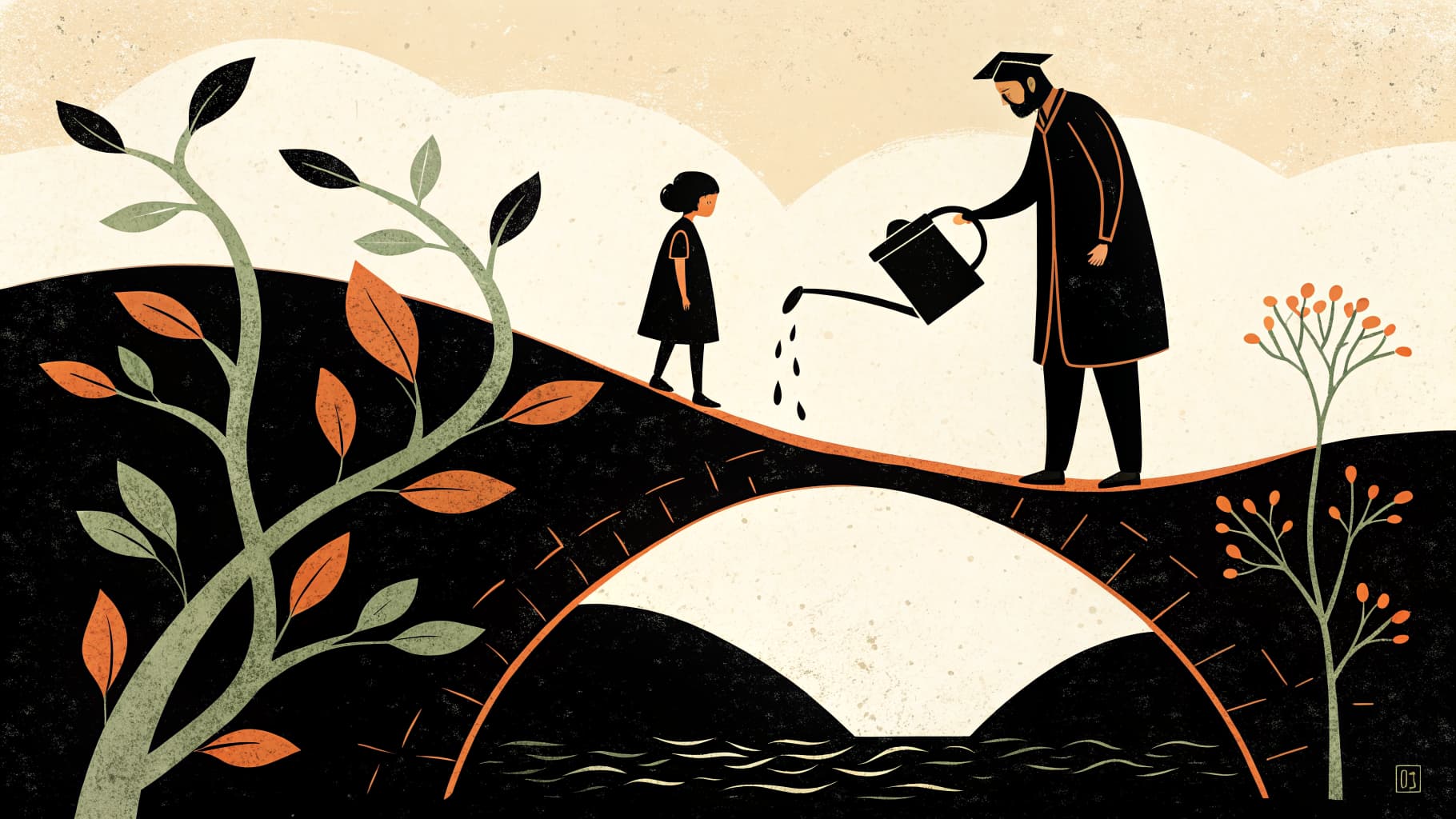
For years, education has celebrated the language of innovation while preserving the structure of passivity. During years of working directly with teachers across five Brazilian states, I realized something uncomfortable: that student silence has nothing to do with understanding. It is pure disengagement dressed in compliance.
Students have the unconscious mindset that school is a cool environment to meet friends, but classrooms are, in general, very boring places. They became remarkably skilled at looking attentive while remaining intellectually distant. Heads nod, notebooks are filled, and instructions are followed (if you are a lucky teacher). Students became very good at performing attention, not at learning. Participation, real cognitive participation, is absent in the lecture-based model.
Students must desperately learn how to learn. For that, active learning is a game-changing methodology. It represents a structural shift in how learning happens because it places the student at the center of their own learning process. It demands movement, dialogue, problem-solving, decision-making, and intellectual risk.
If we are serious about preparing students for a complex world, we must stop discussing active learning as an abstract ideal and begin redesigning classrooms so that thinking is visible, voices are heard, and learning is something students actively build rather than passively receive.
The Research Gap We Keep Ignoring
Here is what we know: active learning works. The evidence is one of the most robust findings in all of educational research. Freeman's 2014 meta-analysis of 225 studies found that students in passive lecture courses were 1.5 times more likely to fail. Hake's study of 6,000 physics students showed that interactive engagement produced learning gains nearly two standard deviations above the mean of traditional instruction classes. Chi and Wylie's ICAP framework demonstrated that constructive and interactive activities consistently outperform passive and active ones.
, Carl Wieman, Nobel Laureate in Physics, Stanford UniversityThe data on active learning is as convincing as any data I've seen in my career, and I've spent my life analyzing data.
These aren't obscure papers buried in journals. They've been cited tens of thousands of times. They've been presented at every major education conference for the past decade. Every school of education teaches them. And yet.
Walk into a middle school classroom in the United States, the United Kingdom, Australia, or Brazil on any given Tuesday. Observational research consistently finds that teacher-directed instruction, specifically lecturing while students take notes, accounts for the majority of instructional time across all four countries, a pattern that has barely shifted in a generation.
Beyond the Knowledge Excuse
The standard explanation is that teachers don't know about the research. This is patronizing and incorrect. The teachers I've worked with across Brazil and Canada are among the most well-read professionals I've encountered. They attend conferences. They read journals. They follow education researchers on social media. They know.
Teachers already have the knowledge. The real obstacle is that we've built a system where doing the right thing is structurally difficult.
Consider what we ask of a teacher who wants to implement think-pair-share in her seventh-grade science class. She needs to redesign her lesson plan (time she doesn't have). She needs to manage the noise level during partner discussions, a real concern in overcrowded schools with thin walls. She needs to assess whether students actually engaged with the material, which is harder than checking a worksheet. And she needs to do all of this while covering a standardized curriculum that was designed around lectures, in a schedule that gives her 45 minutes per class, five classes per day.
The teacher isn't the problem. The system is the problem. And yet every reform initiative I've seen in my career targets the teacher.
What Actually Needs to Change
I didn't start Flip Education because I thought teachers needed another professional development workshop. I started it because I believed we could build tools that make active learning the path of least resistance rather than the path of most resistance.
Three things need to happen simultaneously.
First, the curriculum itself must be restructured around active learning from the ground up, embedded in every unit rather than relegated to a "teaching tip" in the margin. The default unit plan should open with a provocation, move through collaborative investigation, and culminate in student-generated synthesis. Lecture should be the exception, not the rule.
Second, the time barrier must be eliminated. If implementing a fishbowl debate requires 45 minutes of preparation, most teachers simply cannot do it. Teachers often have the will, but the time is not there. The preparation time needs to drop to five minutes or less. This is a design problem, and it's solvable.
Third, we must stop treating active learning as a single methodology and start treating it as a family of approaches matched to specific learning goals. Think-pair-share is not the same as Socratic seminar is not the same as project-based learning. Each has optimal use cases, and teachers need clear guidance on which to deploy when.
Why I Created Flip Education
I believe education is the greatest instrument of social transformation, the key to individual and collective progress. My passion, and the guiding purpose behind all my work, has always been to help educators empower students to exercise their minds and hearts, open the windows of their imagination, and develop their full potential. My goal has always been to help teachers nurture each student's ability to become the proactive creator of their own story, rather than just a passive recipient of knowledge.
After a decade of building IASEA and designing SEL and active learning programs for state education departments across Brazil, I co-founded FlipEducation, a company that builds active learning tools. I did it because I was tired of watching theoretical research pile up while classrooms remained the same in practice. For years, my biggest dream was to find a way to make active learning methodologies scalable and truly accessible to teachers worldwide, but the infrastructure simply didn't exist yet. Now, with AI and new technologies, it finally does.
I've seen firsthand the personal and educational impact active learning methodologies can bring to the lives of teachers and students on a daily basis. I've seen what happens when a teacher implements structured debate for the first time and watches a student who hasn't spoken all semester suddenly light up. I've seen schools where engagement visibly shifted after adopting project-based units. I know how much engagement, fun and laughter active learning activities can bring to a classroom. And don't forget: everything we learn while having fun becomes unforgettable. These are the reasons why FlipEducation exists.
What I'm Asking Of You
If you're a teacher reading this, I'm not asking you to overhaul your practice overnight. I'm asking you to try one active learning strategy, once, this week. Pick the simplest one. Think-pair-share. It takes zero preparation. Ask a question, give students 30 seconds to think, have them discuss with a partner, then share out. That's it.
If it doesn't work, abandon it. But if you see something, a flicker of engagement, a student who usually stares at their desk suddenly turning to their partner, then you'll understand why I co-founded Flip Education to make that moment happen more often.
The research isn't going to get more convincing. We have enough evidence. What we need now is the courage to restructure our systems around what we already know to be true.
The students sitting in our classrooms right now don't have another decade to wait.