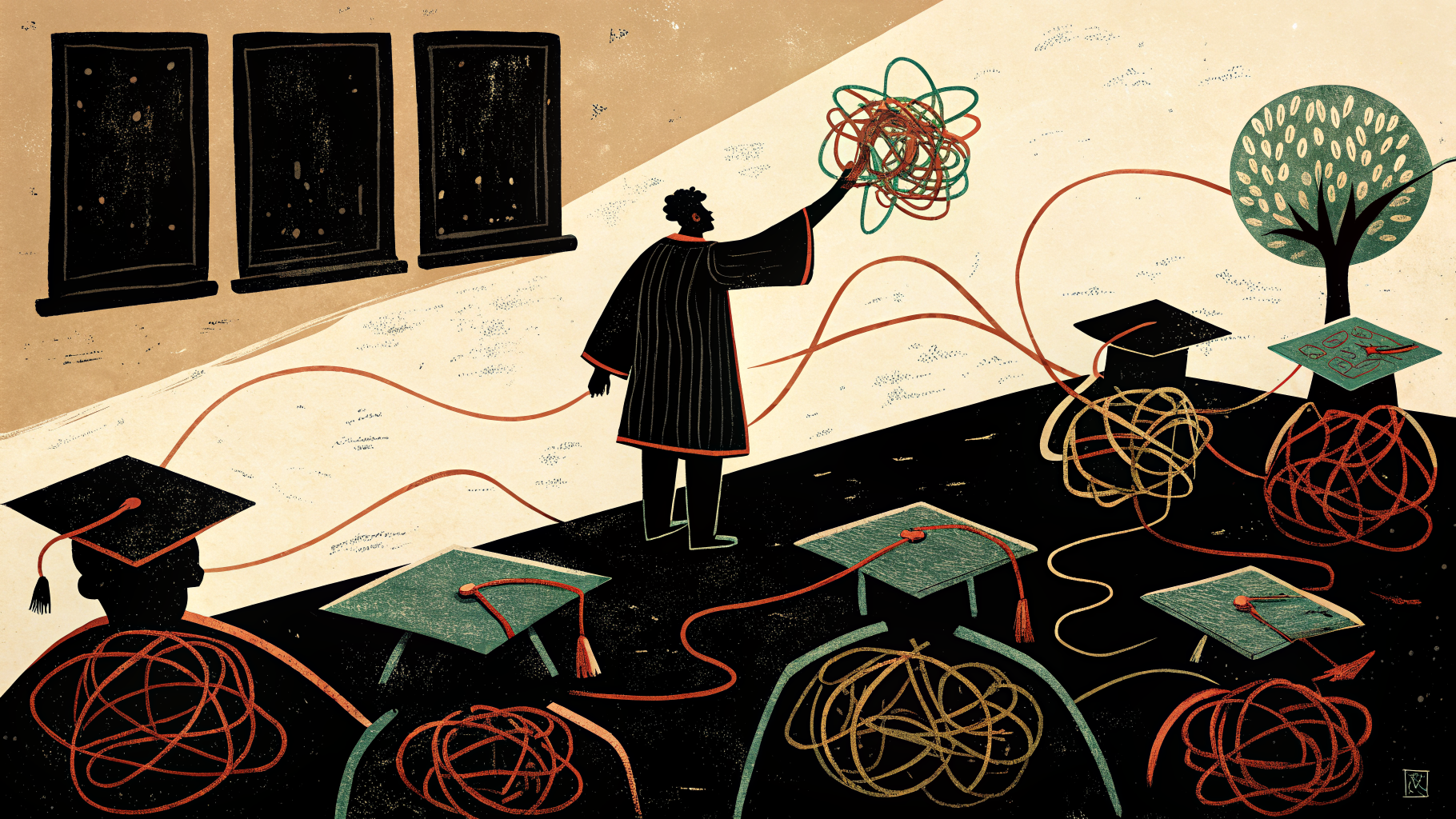
Picture Sunday night at 11 PM. You have three versions of Monday's reading passage open in separate tabs: one for on-level readers, one with simplified vocabulary for students reading below grade level, and one with extension questions for your advanced group. You haven't eaten dinner. Somewhere in the back of your mind, you know that even three versions won't reach Marcus, who has ADHD but reads above grade level, or Priya, who is an English language learner but processes visual information faster than anyone in the room.
This is differentiated instruction in practice. Not the elegant model Carol Ann Tomlinson describes in her foundational texts, but the version that plays out nightly in classrooms with 28 students, one planning period, and a pacing guide that moves with or without you.
The conversation education needs right now is whether the goal of differentiation, responding to individual student needs, is right while the dominant method for achieving it has failed. Five evidence-based reasons suggest it has. Universal Design for Learning offers a more sustainable and more honest alternative. Here are five reasons to stop differentiating instruction as most schools currently practice it and try UDL instead.
The Hidden Cost of Differentiation
The Tomlinson model asks teachers to differentiate by content, process, product, and environment in response to each student's readiness, interest, and learning profile. In theory, this creates a fluid, responsive classroom. In a school with 30-student classes, inadequate prep time, and no instructional coach on staff, it creates an impossible standard.
Teacher attrition remains a persistent challenge in American public education, with working conditions cited alongside compensation as a primary driver of the profession's retention crisis. When teachers describe what makes the job unsustainable, planning demands rank near the top. Differentiated instruction, as typically implemented, is a working conditions problem as much as a pedagogical one.
When differentiation means building three separate lesson pathways for every unit in your curriculum, teachers are not differentiating. They are tripling their workload. At some point, the strategy becomes the problem it was meant to solve.
Meta-analyses do show statistically significant positive effects of differentiated instruction on student achievement, particularly in mathematics. But the research also reveals substantial variability across studies, variability that correlates directly with teacher training, class size, and available resources. Differentiation works best when teachers have time, support, and small enough classes to actually execute it well. That describes a minority of American classrooms, and the research is honest enough to say so.
What Differentiated Instruction Is Not
Before arguing against a practice, it helps to define it. This is where differentiated instruction runs into its first structural problem. There is no universally agreed-upon definition of what the practice actually entails.
In some schools, differentiation refers to the Tomlinson model of tiered tasks and flexible grouping. In others, it has become shorthand for compliance with IEP and 504 plan accommodations. In still others, teachers use it interchangeably with ability grouping, a practice with its own contested evidence base. As education journalist James Delano argued in Education Week, the term has been applied so broadly that it now means almost anything, and therefore functions as a pedagogical standard for almost nothing.
This definitional ambiguity produces real consequences. When a principal checks "differentiation" off a classroom walkthrough form, they may be affirming three entirely different instructional practices depending on the teacher and the school. Without a shared, operational definition, professional development around differentiation stays inconsistent at best.
The students who arguably stand to benefit most from differentiated support, those with the highest and lowest academic needs, sometimes end up worse off. In some districts, the push toward differentiated instruction in general education settings has contributed to scaling back specialized pull-out programs and targeted services for students with learning disabilities and gifted learners. The intended beneficiaries lose out on both ends.
A Foundation Built on Discredited Science
Here is the most damaging critique of differentiated instruction as it is typically practiced: a substantial portion of it rests on a theory that has been scientifically discredited.
Learning styles, the idea that students are visual, auditory, or kinesthetic learners who retain information better when instruction matches their preferred "style," is one of the most pervasive myths in education. It is also one of the most thoroughly dismantled. Research consistently finds no credible evidence that matching instruction to a student's supposed learning style produces measurable gains, and the broader cognitive science community has largely reached the same conclusion.
The "meshing hypothesis," that performance improves when teaching style matches learning style, has repeatedly failed under controlled conditions. Students do have genuine preferences for how information is presented. Those preferences do not reliably predict which presentationmode will produce deeper learning.
Students can prefer visual content and still learn more from a well-structured verbal explanation, depending on the material and their prior knowledge. Preference and optimal learning mode are different things, and conflating them has driven a great deal of misdirected planning time.
When differentiation is organized around learning styles, as it frequently is in district-level professional development trainings, teachers invest enormous energy customizing content for categories that do not hold up to scrutiny. The extra work does not produce better learning. It produces more work and a false sense of scientific grounding.
The Shift from Individualization to Universal Design
Universal Design for Learning was developed by researchers at CAST (the Center for Applied Special Technology), led by David Rose and Anne Meyer, drawing on neuroscience research into how the brain processes, stores, and retrieves information. The framework rests on three principles: multiple means of representation (the "what" of learning), multiple means of action and expression (the "how"), and multiple means of engagement (the "why").
The critical difference between UDL and traditional differentiated instruction is when flexibility enters the lesson. Differentiated instruction builds flexibility into delivery: the teacher designs a lesson and then creates separate versions for different learners. UDL builds flexibility into design: the lesson is structured from the start to offer multiple pathways, so no parallel versions are required.
This distinction matters enormously for workload. Instead of building three tiers of a reading passage, a UDL-informed teacher might provide the original text alongside a text-to-speech option, embed a vocabulary glossary into the document, and offer students two ways to demonstrate comprehension (a written response or a structured discussion protocol). Optional extension questions appear in the same document, not in a separate advanced version.
Every student accesses the same core content. Scaffolds and extension opportunities are built in, not layered on afterward. The teacher plans once.
This is also where student-driven differentiation becomes a practical reality rather than a planning aspiration. When students have genuine choice over how they engage with material and how they demonstrate learning, the differentiation happens through their decisions rather than through the teacher's advance sorting.Curriculum compacting, which accelerates content for students who demonstrate early mastery, can be embedded into a single lesson structure rather than requiring a parallel advanced track. The teacher stops managing tracks and starts managing learning.
High-Impact, Low-Burnout Strategies
The practical question once you decide to stop differentiating instruction in the traditional sense is: what do you do instead? Student variability is real and it matters enormously. The problem is not the goal but the method. Strategies that address variability without unsustainable individualized planning do exist.
Learning stations allow students to rotate through different modes of engaging with the same content (reading, discussion, hands-on activity, digital practice) without requiring separate lesson plans for each group. Every student cycles through every station. The differentiation comes from the range of modalities, not from teacher-assigned tracks. Setup takes time upfront but does not multiply across student groups.
Formative assessment loops (short, frequent checks for understanding such as exit tickets, quick polls, and structured pair-shares) shift differentiation from a planning problem to a teaching problem. Instead of anticipating who will struggle and building for them in advance, teachers see who needs support now and respond. Research on formative assessment consistently shows strong effects on learning outcomes, particularly for students who are already behind.
Choice boards give students a menu of ways to engage with content or demonstrate mastery. When structured around the same learning objective, they serve students with different strengths and preferences without requiring the teacher to design separate tracks. A student with dyslexia, a student who is an advanced reader, and a student who is an English language learner can all work from the same choice board and find a viable path.
These strategies serve neurodivergent learners not by sorting them into a separate track but by making the whole-class experience more navigable for everyone. What you build for the most constrained users tends to work better for all users. That is the core logic of Universal Design, and it applies as cleanly in education as it does in architecture or software development.
Workforce Readiness and the Real-World Critique
One argument for differentiated instruction is that it helps struggling students succeed by meeting them where they are. The less-examined counterargument is what happens when that support disappears.
College professors do not provide three versions of a syllabus. Entry-level employers do not redesign job requirements for individual learning profiles. If students spend years working primarily from materials calibrated to their current readiness level, the transition to standardized expectations can be abrupt and destabilizing, precisely at the moment students are least positioned to absorb that disruption.
This is not an argument for ignoring where students are. It is an argument for being clear-eyed about what differentiation is preparing students for. The goal should be building student capacity to navigate challenging, standardized content independently, not permanently mediating between the student and the material. UDL supports this goal because its scaffolds are designed to fade over time, teaching students to deploy strategies for themselves rather than waiting for teacher-designed versions of every task.
The long-term impact of sustained differentiation on the achievement gap between high- and low-performing students remains an open question in the research literature. Some studies suggest it narrows the gap; others indicate that lower-track differentiation can become a ceiling rather than a floor, cementing rather than closing the distance. More longitudinal research is needed before anyone can make strong claims in either direction. That uncertainty alone should prompt educators to examine the practice more rigorously than most professional development conversations currently allow.
What This Means for Your Practice
If you have been working heroically to differentiate every lesson, you are not doing it wrong. You were handed an expectation the system never gave you adequate time or support to meet. You were also handed a framework built partly on debunked science and handed it without a clear definition of what success would even look like.
Stopping differentiated instruction as it is commonly practiced is not abandoning students with varied needs. Student variability is real, but it requires a smarter response than multiplying your planning workload by three. UDL builds that smarter response into the design of the lesson rather than the delivery, which changes the teacher's role from managing separate tracks to facilitating a single, flexible learning environment.
Start small. Take one upcoming unit and apply the three UDL principles at the design stage: how can students access the content in more than one way? How can they demonstrate what they know through more than one format? What choices can you build in to sustain genuine engagement across a diverse classroom? You do not need to redesign your entire curriculum in a weekend.
But you do deserve to sleep on Sunday nights. And your students deserve a framework grounded in what the science actually says.