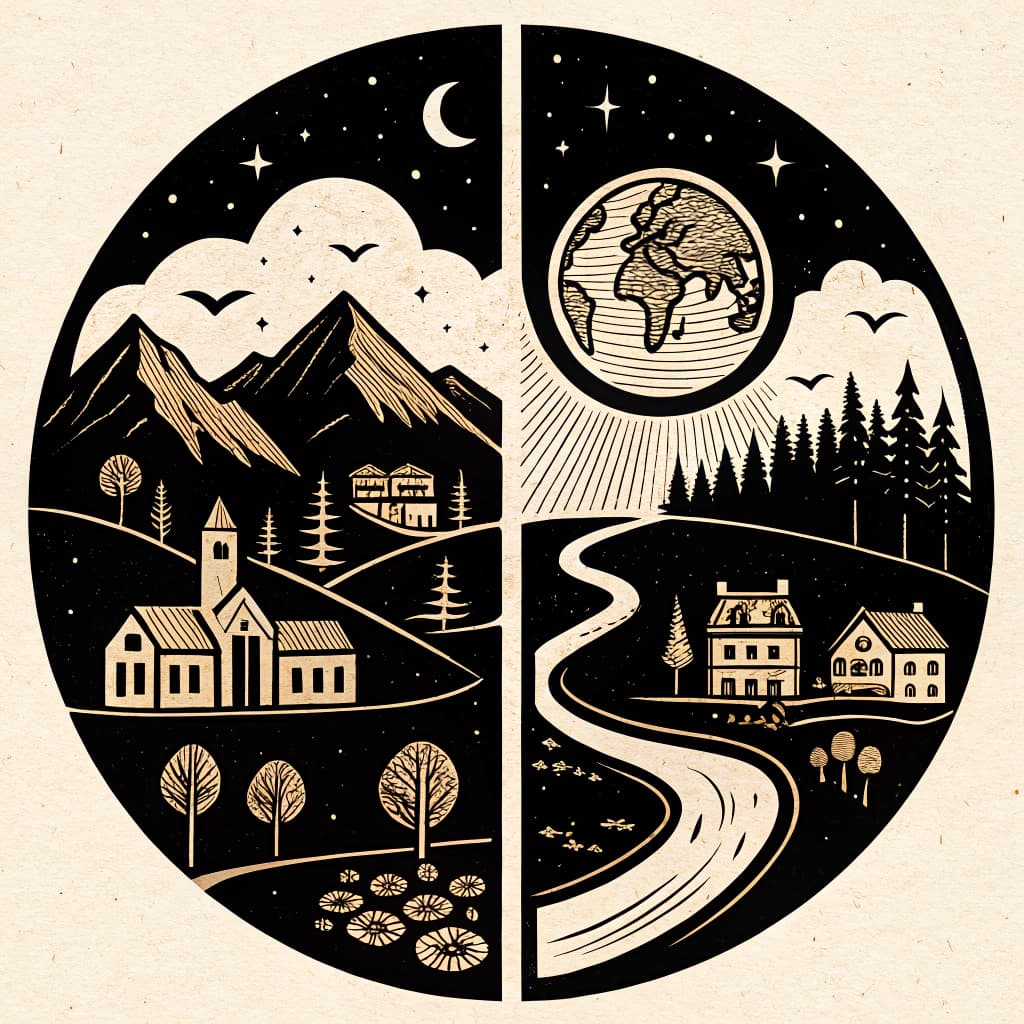
Exploring Landforms and Waterways
Students identify mountains, plains, plateaus, rivers, and lakes, and how these features shape human settlements.
TL;DR:Active learning helps second graders grasp landforms and waterways because these concepts require spatial reasoning and real-world connections. Hands-on activities let students manipulate materials, discuss ideas, and test their own ideas about how land features shape human behavior.
About This Topic
Exploring Landforms and Waterways guides second graders to identify and describe key physical features: mountains with steep slopes and high peaks, plains as flat open areas, plateaus as raised flat lands, hills as gentle rises, rivers as flowing water channels, and lakes as standing bodies of water. Students compare these features and explain their influence on human settlements. For example, communities develop near rivers for fresh water, transportation, irrigation, and rich soil for farming. They also locate prominent landforms and waterways in their state using simple maps.
This topic aligns with the Geography and the Environment unit and C3 standards D2.Geo.2.K-2 for map construction and D2.Geo.3.K-2 for human-place interactions. It builds foundational geographic vocabulary, spatial awareness, and understanding of how environment shapes daily life in communities near and far.
Active learning excels with this content because students handle tangible models and collaborate on maps. Building clay landforms or simulating settlements near paper rivers lets children observe cause-and-effect relationships firsthand. These experiences solidify concepts through touch, talk, and trial, making geography memorable and relevant.
Key Questions
- Differentiate between various landforms like hills, mountains, and plains.
- Explain the reasons why human settlements often develop near rivers.
- Identify the prominent landforms and waterways within our state.
Learning Objectives
- Compare and contrast at least three different landforms (e.g., mountains, plains, plateaus) based on their shape and elevation.
- Explain the primary reasons why early human settlements were established near rivers.
- Identify and label at least two major landforms and two major waterways on a map of their state.
- Classify different types of waterways, such as rivers and lakes, based on their characteristics.
Before You Start
Why: Students need to understand how to read simple maps and identify symbols before they can locate landforms and waterways on a state map.
Why: Understanding different community types (e.g., rural, urban) helps students connect geographic features to human settlement patterns.
Key Vocabulary
| Mountain | A large natural elevation of the Earth's surface rising abruptly from the surrounding level; a large steep hill. Mountains often have steep slopes and high peaks. |
| Plain | A large area of flat or gently sloping land with few trees. Plains are often used for farming or building communities. |
| Plateau | An area of high, flat land. Plateaus are like large, raised tables of land. |
| River | A large natural stream of water flowing in a channel to the sea, a lake, or another such stream. Rivers are important for transportation and providing water. |
| Lake | A large body of water surrounded by land. Lakes can be natural or man-made and are sources of water and recreation. |
Watch Out for These Misconceptions
Common MisconceptionMountains are just very big hills.
What to Teach Instead
Mountains rise higher with steeper sides than hills. Hands-on stacking of blocks or playdough at stations lets students build and measure differences, fostering comparison through direct manipulation and peer talk.
Common MisconceptionPeople can build settlements anywhere equally well.
What to Teach Instead
Settlements favor rivers and plains for resources and flat ground. Settlement simulations in pairs reveal why steep mountains limit building, as students test house placement and discuss trade-offs.
Common MisconceptionRivers and lakes are the same because both have water.
What to Teach Instead
Rivers flow with direction; lakes collect in basins. Model stations with tilting trays for rivers and bowls for lakes help students observe movement differences and connect to real maps.
Active Learning Ideas
See all activities→Stations Rotation
Landform Stations
Prepare five stations with photos, toy models, and labels for mountains, plains, plateaus, hills, rivers, and lakes. Students rotate every 7 minutes, sketch each feature, note one characteristic, and discuss how people might use it. Conclude with a gallery walk to share drawings.
Hundred Languages
Pairs: River Settlement Game
Give pairs blue yarn for a river on paper, green for plains, brown for hills. They place paper houses, farms, and roads, explaining choices like 'near river for water.' Pairs present to class and adjust based on feedback.
Hundred Languages
Whole Class: State Landforms Map Hunt
Project or display a state map. Call out features; students point and name them. Then, in a shared chart, list local examples and one way they affect communities, like rivers for boating.
Real-World Connections
- City planners and civil engineers study landforms to decide where to build roads, bridges, and housing developments, considering factors like slope and stability. For example, building a highway through a mountain range requires extensive planning and construction.
- Farmers in the fertile river valleys of the Midwest use the rich soil deposited by rivers for growing crops like corn and soybeans. They also rely on river water for irrigation, especially during dry seasons.
- Historical settlements, like ancient Rome near the Tiber River or early Egyptian civilization along the Nile River, grew because these waterways provided fresh water, fertile land for agriculture, and routes for trade and travel.
Assessment Ideas
Provide students with a worksheet showing outlines of different landforms and waterways. Ask them to label each feature and write one sentence explaining why a community might settle near a river.
During a class discussion, ask students to hold up a hand signal (e.g., fist for mountain, flat palm for plain) to identify landforms shown in pictures. Then, ask: 'Why did people build this town so close to the river?'
Present students with a simple map of their state highlighting major landforms and waterways. Ask: 'Looking at this map, what are two important geographic features in our state? How might these features affect where people live or work?'
Frequently Asked Questions
How to teach landforms and waterways to 2nd graders?
Why do human settlements develop near rivers?
How can active learning help students understand landforms and waterways?
What are key landforms in US states for 2nd grade?
Planning templates for Communities Near & Far
5E Model
The 5E Model structures lessons through five phases (Engage, Explore, Explain, Elaborate, and Evaluate), guiding students from curiosity to deep understanding through inquiry-based learning.
Unit PlannerThematic Unit
Organize a multi-week unit around a central theme or essential question that cuts across topics, texts, and disciplines, helping students see connections and build deeper understanding.
RubricSingle-Point Rubric
Build a single-point rubric that defines only the "meets standard" level, leaving space for teachers to document what exceeded and what fell short. Simple to create, easy for students to understand.
More in Geography and the Environment
Continents and Oceans of the World
Children identify the seven continents and five oceans, understanding the large-scale layout of the Earth.
8 methodologies
Understanding Map Keys and Symbols
Students learn to decode maps using legends, compass roses, and cardinal directions to navigate and find locations.
8 methodologies
Climate and Natural Resources
Children explore how weather patterns and natural resources like timber, water, and soil affect a community's economy.
8 methodologies
Weather Patterns and Seasons
Students investigate different weather patterns and the concept of seasons, understanding their impact on daily life and the environment.
8 methodologies
Human Impact on the Environment
Children learn about ways humans interact with and change their environment, both positively and negatively, and the importance of conservation.
8 methodologies